Tuesday, April 26, 2016

Timeline of Space Using TikiToki


Today my colleagues and I created a timeline of different discoveries regarding space. We completed this timeline after creating a word cloud using Tagul. We chose to use TikiToki as our website of choice in order to create this timeline. We included facts about Copernicus, The start of NASA, the discovery of Gravity, Pluto not being a planet anymore, all the way to present day and the discovery of Planet 9. I found this website to be one of the most useful interacting websites I have ever used! The timeline lets you add pictures with descriptions under each. It also allows for you to present the timeline in a 3D mode which makes it so much cooler! I wish that I had knew about this website for Social Studies methods as it would have come in handy! I will definitely be using this website in my future classroom, in multiple subjects, for years to come. 

Tuesday, April 19, 2016

Atmosphere Presentation Using Powtoon


By clicking on the image above, you can view the Powtoon Jackie and I created about the atmosphere. For this project, we had to pic a topic we did not feel that we knew a lot about nor were we comfortable with, and research it in order to become more informed on the topic. The topic my colleage and I chose was Atmosphere. The rest of the class also chose this topic, therefore it must have been a subject that everyone felt they should know more about. In our presentation, we discussed the different layers of the atmosphere: The Troposphere, the Stratosphere, the Mesosphere, the Ionosphere, and the Exosphere. I thoroughly enjoyed using Powtoon as it was a different take on a typical slideshow presentation. While it was pretty difficult to figure out at first, one you got the hang of it, it created for a great presentation. I also liked how you can include music in the background, add animations, and my favorite: a hand-writing animation that made the text appear as if it was being written by a hand! I will definitely be using Powtoon in my future classroom as a more engaging way to present a topic than a typical PowerPoint.   

Tuesday, March 8, 2016

My Fieldwork Day


Today My colleagues and I taught our unit titled "Rocks Rock!" to the students at Bishop Dunn Memorial School. We started off the lesson with a pre-test and then asked the students the question "What do you think of when you think of rocks?" The students were then to write their answer down on a sicky note and place it on a rock poster at the front of the class. Then my peers and I went into our direct instruction lesson which checked for student understanding with "STop and Ponder" questions throughout the presentation. We then included an interactive SmartBoard activity  where students were able to come up to the board and see whether different rocks were permeable, wore well, or if they could float or sink. The students particularly enjoyed this activity. 

We then transitioned into our inquiry lesson where students had to look at six different kinds of rocks and say whether they belonged to the igneous, sedimentary, or metamorphic categories. Students wee given a chart in order to record their observations of the rocks' grain size, luster, shape, etc. The class was split into three groups and luckily there were three of us teaching the lesson so each of us were able to work with a group. This allowed for us to guide the students through the inquiry process and help struggling learners if need be. In my group in particular I had a student who needed help spelling almost every word we decided to record on our chart, and I was able to give him the help he needed. 

In the end, I feel as though our fieldwork was successful and that students did learn more then they knew about rocks prior to entering the classroom. When working with them in their groups, I found that they had retained the information from the direct instruction so much so that they were even naming the rock rather than just its category. For example, members of my group knew one of the rocks was obsidian because they remembered from direct instruction. I am sad that fieldwork has come to a close but I am also relieved that my colleagues and I have completed and were able to deliver the lesson with no issues. 

Monday, February 29, 2016

Science Fair

Today I handed in my Science Fair project to Mrs. Foster-Faith, as tomorrow is the Bishop Dunn Memorial School Science Fair for the elementary school. For my science project, I did an experiment titled "Go Bananas." For this experiment, I tested which setting causes bananas to brown the fastest. I tested four bananas: one on the counter top, one in the fridge, on in a brown paper bag, and one in a Ziploc bag. After a week, the result was that the Ziploc bag preserved the banana the best while the banana in the fridge browned the fastest. On my science fair project, I included a table as well as multiple pictures showing each of the bananas in the beginning of the process and at the end of the process. 

Initially, the idea of completing a science fair project did not seem appealing to me. But after I completed the project and got to see my classmates' different projects, I became glad that we had to complete this assignment. Participating in a science fair as an adult opened up my eyes to how important science is for students. A project like this is important so students can practice the scientific method and also take on the responsibility of completing an assignment that they may have to do over the course of several days. 


Here is my reflection paper on the process.

Friday, February 19, 2016

Bishop Dunn Science Fair

Today, February 19th, I attended the Bishop Dunn Science Fair. Today's Science fair consisted of projects from the middle schoolers (grades 6-8) at Bishop Dunn Memorial School. When I arrived at the Science fair Mrs. Foster-Faith told me to have a look around and get some ideas for my own science fair project. Right away, I was impressed with the quality of work that the middle schoolers produced for their projects. Some were definitely more thought out than others, however. For instance, there was one entitled "Lasting Lips" that tested the lasting power of affordable lipsticks versus more expensive lipsticks. While there was a testable hypothesis, it was still an experiment that could have been done last minute. The scientist could have also made their presentation more appealing to the eye as well as included an assortment of brands rather than only two.


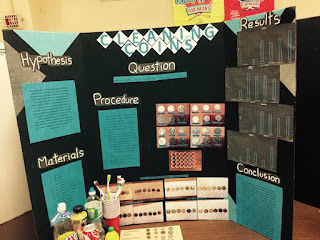
On the other hand, there was a project that tested cleaning different pennies with various products and utensils. This student took a simple concept and made a very eye-catching presentation as well as extensively testing the different products on the coins. The student included many photos as well as informative graphs. The student even took the extra mile to bring in the different products they used on the coins, even the toothbrushes! 


Overall, I think attending this Science Fair gave me an idea of the direction I want to take with my Science Fair project. After taking a look at all the middle school projects, I now realize what makes a good science fair project versus one where there might not have been as much effort put in. Attending this Science Fair also made me aware of how important it was to get each student involved in order to make science have meaning in their daily lives.  


Tuesday, February 16, 2016

Online Class


Today we had an online, virtual class in place of regular class since fieldwork was postponed because of snow. At first I was hesitant about what the virtual class was going to consist of. After I logged on, however, I thought the concept of a virtual class was very useful. The professor was able to put up a PowerPoint and point at certain areas on the screen as she spoke. The rest of the class was able to then "raise their hand" if they wanted to say something and either type it or turn their microphone on and speak up. I overall thought the online class was very successful and very helpful. Although I experienced a few technical difficulties, it was still worthwhile. I learned more in depth about what makes a good goal and an objective as well as how to better plan an inquiry lesson for the students. I think this virtual class was a great tool to use in place of class today and I hope we can use it again. 

Monday, February 1, 2016

Scientific Me Project


Science is a very important subject to teach to children in the classroom. Since some students may be reluctant when it comes to this subject, it is crucial that teachers carefully choose the methods in which they use to teach it. As teachers, it is likely that we either grew up with bad experiences when it comes to science, positive experiences, or a mixture of the two. We then have these experiences affect how we teach our students. I overall have a moderate recollection of how science was presented to me growing up. There are certain projects which I had a special interest in as well as some lessons which stood out more than others. In most of my dominant memories, the parallel seems to be that hands-on activities helped me to remember the most about a topic when it came to the subject of science. Therefore, in order to keep my future student engaged in a lesson I will plan different activities to go along with direct instruction in order to help students ultimately comprehend the lesson.
I have many memories here and there about my experiences with science up until the present day. In primary school, my fondest memory of science includes watching caterpillars turn into butterflies. When they became butterflies it was an exciting day because it meant that as a class we were able to go outside and watch them get released. It is hard for me to remember much from primary school but this experience is one that stand out, all the way down to the cage we kept the butterflies in. Perhaps it stands out so fondly in my memory because it was a project my classmates and I were invested in. Rather that reading about butterflies we got to experience it firsthand and we were able to be involved in their metamorphosis. Similarly to the butterflies, I remember participating in the “lima bean in a bag” experiment in elementary school. Again, this project was one that my classmates and I were able to be a part of and witness rather than only having to read out it.

 In elementary school, my school had a program where classes would switch with each other for science and social studies. So in first grade when it came time for science class, we would go to the teacher next door for science and her class would come to our room for social studies. Perhaps this program was to help us get ready for middle school or perhaps it was a way for us to be able to change our environment. Either way, the program is a memory of mine that stands out because it allowed for me to look forward to science class instead of dreading it. One of the projects I remember the most in elementary school was an animal project where each student was supposed to pick and research an animal and then present their findings. I researched a panda and put my findings into a panda-shaped book, complete with black and white fur of course. This project allowed for me to become an expert on the topic of pandas and retain information that I have kept with me till this day. This project also allowed for me to know more about the various animals my classmates researched and expand my knowledge.
As time went on, science became harder and harder. I remember enjoying certain experiments in high school such as making bottle rockets in physics or roasting marshmallows in chemistry. I also remember being fascinated by certain lessons such as the stars or the human brain. As interesting as it was, science grew harder in high school and became something I did not look forward too. What was once interesting to me became packed with lab reports and a memorization of facts, including the always difficult memorization of a cell. I try not to have these experiences deter me as a teacher however, because I know that science is interesting and can be something students look forward to as long as it is presented in the right way.
As I reflect on my past experiences of science, I find that the general characteristics that seem to be meaningful to me is when lessons are presented in a more hands-on manner. In an analysis of my favorite projects and lessons, it is clear that the topics that have resonated with me the most are ones where I was able to see the science happen in front of my eyes and experience it firsthand. The characteristics of science experiments that seem to be a turn-off for me is when I am required to memorize data and facts and have no real world application of the topic.
I feel that I have always been successful in science because I am a generally hard worker. Science has never been my favorite subject and there were times, specifically biology, where I struggled. However, I was able to invest enough of my time into the class in order to get a good grade. In the long run however, I do not feel as though I am successful with science. There is a difference between memorizing facts in order to pass a test and having these certain facts resonate with you for years to come. Maybe it is because I do not see myself as being good in science that I never took an interest in it. I never felt confident enough in it to pursue a career that involved a lot of science, such as nursing.
Science is a very diverse subject therefore it is difficult to define. I think science is the study of a multitude of disciplines in both the physical and natural world as tested through questioning and experimentation. How I view science is something that is based on evidence yet can also change. There are new developments every day that further support certain theories or even prove them wrong. To me, science also explains many of the marvels that exist in our world today, like why we have seasons, why we are considered mammals, and why there are other solar systems besides ours, just to name a few. As much as I may not have felt I excelled in science as a student, I was always curious about it and certain explanations for why the world is the way it is. To this day I find myself researching online in order to find the answers to science-related questions I may have.
My past learning experiences with science have shaped my definition of science by allowing me to see how diverse of a subject it is. Throughout my schooling, I have been exposed to various disciplines of science including earth science, astronomy, biology, and chemistry. These are all disciplines within the subject of science that children should learn throughout their years in school. As a future educator I will make it my duty to ensure that my students are given the opportunity to learn within these multitude of topics as well.
One characteristic that I have also experienced when studying science is that it involves a variety of other subjects. Most frequently, science deals with the subject of math. Math can help students collect as well as analyze data. Reading comprehension is also important in order for students to analyze certain information. Even history is applicable in order to know the background of science and certain scientists and discoveries that were made in the past. As a future teacher, it is important that I not only teach science to my students but apply various subjects to my lessons in order for them to practice a number of skills.